Scan, Search, Ranking
scan
scan, prefix sum
- Given an array, \([4, 2, 1, 8]\)
- Compute, \([4, 4+2, 4+2+1, 4+2+1+8]\)
- \([4, 6, 7, 15]\)
obvious sequential algorithm
\[ D_s(n) = (n) \]
not parallelizable, need to change algorithm
scan
- a good example of a computation that seems inherently sequential, but for which there is an efficient parallel algorithm
- prefix-sums can be used to convert certain sequential computations into equivalent, but parallel, computations
scan
Given a binary associative operator \(\bigoplus\) with identity \(I\), and an array of \(n\) elements, \([a_0,a_1,\cdots,a_{n-1}]\), compute:
\[ \left [ I, a_0, (a_0\oplus a_1),\cdots,(a_0\oplus a_1 \oplus \cdots \oplus a_{n-2}) \right ] \]
the exclusive scan or the inclusive scan,
\[ \left [ a_0, (a_0\oplus a_1),\cdots,(a_0\oplus a_1 \oplus \cdots \oplus a_{n-1}) \right ] \]
sequential scan
// exclusive
out[0] = 0;
for (k=1; k<n; ++k)
  out[k] = in[k-1] + out[k-1];
\[ T_1(n) = \mathcal{O}(n) \]
parallel scan
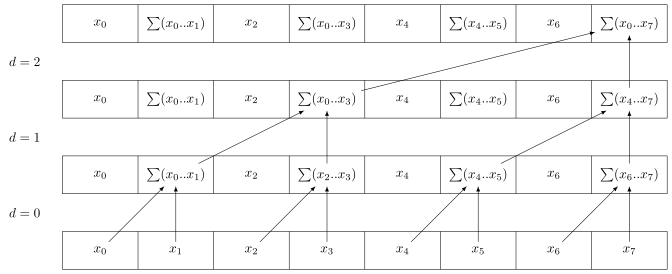
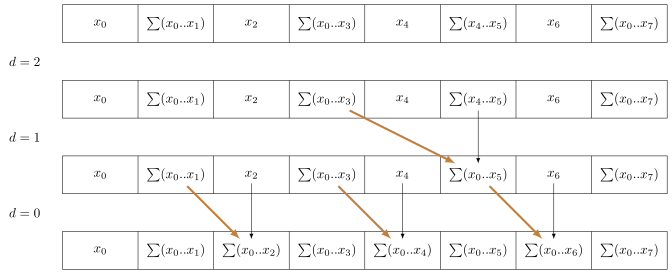
- binary tree (like sum)
- two tree traversals
- up-sweep bottom-up — reduce phase
- down-sweep top-down
- Work/Depth
- \(W(n) = \mathcal{O}(n)\)
- \(D(n)=\mathcal{O}(\log n)\)
- recursive & iterative implementations
scan up-sweep
scan down-sweep
simple use case
parallel select
parallel select
- consider a shared memory machine (PRAM)
- given an array \(A\), we wish to select all entries of \(A\) satisfying some condition
- say, we are implementing quicksort and would like to compute,
- all values less than a given pivot.
parallel select for a[i] < pv
(l,m) = select_lower(a, n, pv) {
  // t = t[0,...,n-1]
  parallel for (i=0; i<n; ++i)
    t[i] = a[i] < pv;
  s = scan(t);
  m = s(n-1);
  // allocate l
  parallel for (i=0; i<n; ++i)
    if (t[i])
      l[s[i]-1] = a[i];
}
\[W=\mathcal{O}(n), D=W=\mathcal{O}(\log n)\]
parallel thinking
think about whether parallelscan can be used for any of the problems in assignment 1
search
parallel search
problem description
- given a sorted list \(X\) of size \(n\) and an element \(y\)
- find the index \(i\), such that \(x_i \leq y < x_{i+1}\)
sequential
- use binary search
- \(\mathcal{O}(\log n)\) time
work / depth
parallel for (i)
  if (x[i] <= y < x[i+1]) return i; // no duplicates
PRAM
- \(\mathcal{O}(\log n/ \log p)\) using \(p\) processors
parallel search
- split \(X\) into \((p+1)\) segments
- compare \(y\) with the \(p\) splitters (boundary elements)
- we will find, \(i\) such that,
- \(X_i = y\), or
- \(X_{ni/(p+1)} < y < X_{n(i+1)/(p+1)}\) — bucket
- if case 1, stop
- if case 2, and size of bucket is \(\sim p\)
- do \(p\) comparisons in parallel
- else recurse
parallel search
example
parallel search
- \(p\) processes
- \(\mathcal{O}(p)\) work per step, \(\mathcal{O}(1)\) depth
- $p^k = n k = _p n $
- Work optimal ?
no parallelism if we insist on work optimality
ranking
ranking
- given ordered lists, \(A,B\) of lengths \(n, m\)
define:
rank$(z:A) $ number of elements \(a_i|a_i\leq z\)
define:
rank\((B:A) := (r_1,r_2,\cdots,r_t)\)
$r_i$ rank\((b_i:A)\)
parallel ranking
- A = [7, 13, 25, 26, 31, 54]
- B = [1, 8, 13, 27]
- Rank(B:A) = (0, 1, 2, 4)
- Rank(A:B) = (1,3,3,3,4,4,4)
algorithm for Rank(b:A)
- ranking one element in an array A
- use a binary search algorithm
- Depth
- sequential search \(\mathcal{O}( \log(n) )\)
- parallel search \(\mathcal{O}( \log(n)/\log(p) )\)
merge sort
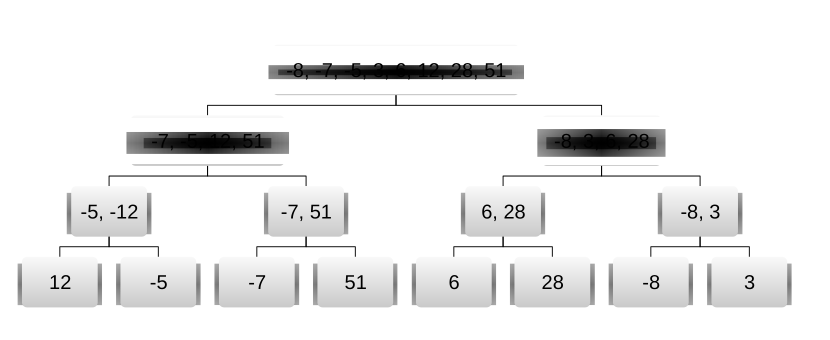
divide & conquer mergesort
- divide \(X\) into \(X_1\) and \(X_2\)
- sort \(X_1\) and \(X_2\)
- merge \(X_1\) and \(X_2\)
- uses a binary tree
- bottom-up approach
- start with the leaves
- climb to the root
- merge the branches
- requires parallel merge
mergesort - example
mergesort
b = Merge_Sort(a,n)
  if n < 100
    return seqSort(a, n);
  b1 = Merge_Sort(a[0,…,n/2-1], n/2);
  b2 = Merge_Sort(a[n/2,…,n-1], n/2);
  return Merge (b1, b2);
parallel merge
merging two sorted lists
- best sequential time — \(\mathcal{O}(n)\)
parallel merge
tradeoffs between
- depth-optimal
- work-optimal
merging using ranking
- Assume elements in \(A\) and \(B\) are distinct
- Let \(C\) be the merged result. Given, \(x \in C\) and rank\((x:C)=i\)
- \(c_i=x\)
- rank$(x:C) = \(rank\)(x:A)+\(rank\)(x:B)$
- Solution to the merging problem,
- find rank\((x:A)\) and rank\((x:B)\)
parallel searches using \(p=nm, D=\mathcal{O}(1)\) but \(W=\mathcal{O}(n^2)\)
Concurrent binary searches, \(D=\mathcal{O}(\log n)\) and \(W=\mathcal{O}(n \log n)\)
Goal: Parallelize with optimal work
work-optimal merge
work-optimal parallel merge

work-optimal parallel merge

partition \(B\) into blocks with \(\log m\) elements
work-optimal parallel merge
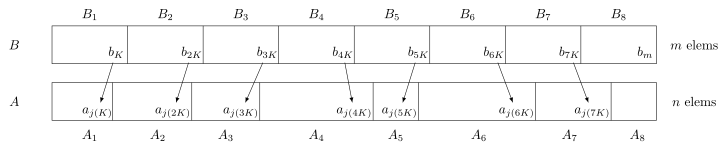
rank splitters of \(B\) in \(A\)
work-optimal parallel merge
partition \(A\) accordingly
work-optimal parallel merge
merge blocks \(B_i\) and \(A_i\) sequentially
work-optimal parallel merge
- partition \(B\) into \(m/\log m\) blocks, each with \(\log m\) elements
- parallel for \(i=1:m/\log m\)
- $r_i = \(`seq_rank`\)(b_{iK}: A)$
- partition \(A\) accordingly
- block \(A_i: (a_{r_{i-1}+1},\cdots,a_{r_i})\)
- merge blocks of \(A\) and \(B\) sequentially in \(\mathcal{O}(\log n)\) time
- but, if \(|A_i|\gg|B_i|=\log m\) then
par_merge\((B_i, A_i)\)
work-optimal parallel merge
assuming \(m=\mathcal{O}(n)\),
\[W=\mathcal{O}(n)\]
and,
\[D=\mathcal{O}(\log n)\]
next time …
- bitonic sort
- sample sort
self-test questions
- design a work-optimal ranking algorithm
- similar to parallel merge
- what are the challenges of implementing the parallel merge in a shared memory framework? how about using message passing?
- can you implement a parallel mergesort using the algorithms discussed today? What will its time complexity be?