Shared Memory & Network Models
story thus far …
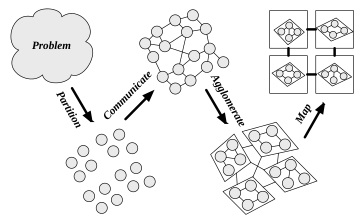
four step design methodology
message passing interface
minimal set of six MPI functions we will need
  // Initiates use of MPI
  int MPI_Init(int *argc, char ***argv);

  // Concludes use of MPI
  int MPI_Finalize(void);

  // On return, size contains number of processes in comm
  int MPI_Comm_size(MPI_Comm comm, int *size);

  // On return, rank contains rank of calling process in comm
  int MPI_Comm_rank(MPI_Comm comm, int *rank);

  // On return, msg can be reused immediately
  int MPI_Send(void *msg, int count, MPI_Datatype datatype,
  int dest, int tag, MPI_Comm comm);

  // On return, msg contains requested message
  int MPI_Recv(void *msg, int count, MPI_Datatype datatype,
  int source, int tag, MPI_Comm comm, MPI_Status *status);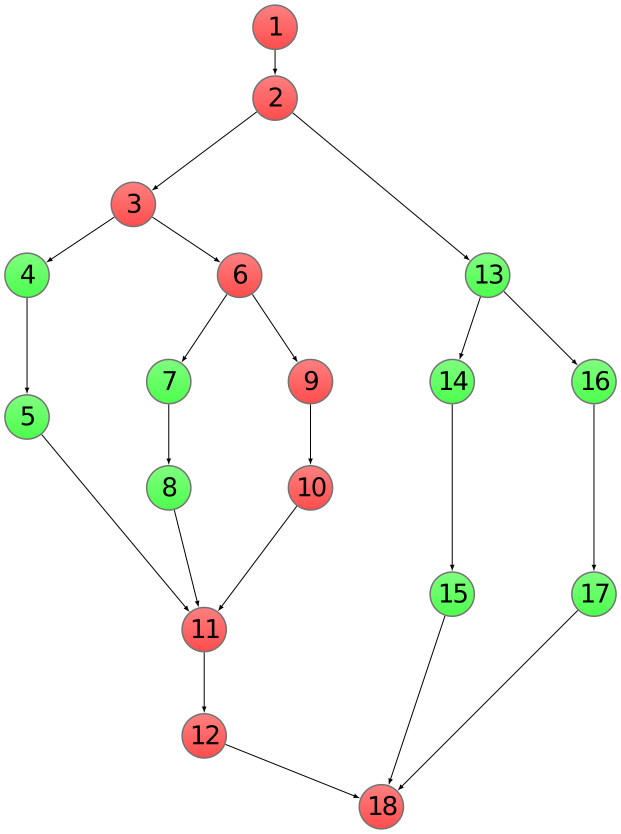
example: reduction
Given \(A\in\mathbb{R}^n\), compute \(\sum_{i=1}^n A_i\)
// option 1
double sum1(double *A, int n) {     //    W     D
  double sum=0.0;                   //    1     1
  for (i=0; i<n; ++i) sum += A[i];  //    n     n
  return sum;                       //    1     1
}
\[ W(n) = 2 + n, \quad D(n) = 2 + n, \quad P(n) = \mathcal{O}(1) \]
// option 2
double sum2(double *A, int n) {     //    W     D
  if (n == 1) return A[0];          //    1     1
  parallel for (i=0; i<n/2; ++i)    //    n     1
    B[i] = A[2i] + A[2i+1];
  return sum2 (B, n/2); }           //  W(n/2) D(n/2)
\[ W(n) = n + W(n/2), \quad D(n) = 1 + D(n/2), \quad P(n) = \mathcal{O}(n/\log n) \]
today
- PRAM
- Network Models
- Collective communications
PRAM
- parallel random access memory
- shared memory model (synchronous)
- SIMD - specify code for single thread
- same instruction for all threads
- no memory access cost
- each thread has its own memory along with shared memory
- shared memory variables must be declared
- global/local memory (read/write)
- ER/CR: exclusive read, concurrent read
- EW/CW: exclusive write, concurrent write
- CREW PRAM: most practical
- Complexity estimates: \(T(n,p), W(n,p)\)
PRAM sum
# t: thread id, p: number of threads (n,p: power of two)
PRAM_sum(A,n):
  if n > p:
    r = n/p
    w = SEQ_sum (A[tr], r)
    S[t] = global_write (w)      # EW
    return PRAM_sum (S, p)

  if t <= n/2:
    a1 = global_read (A[2t])     # ER
    a2 = global_read (A[2t+1])   # ER
    S[t] = global_write(a1+a2)   # EW
    return PRAM_sum (S, p/2)
PRAM MATVEC
PRAM MATVEC
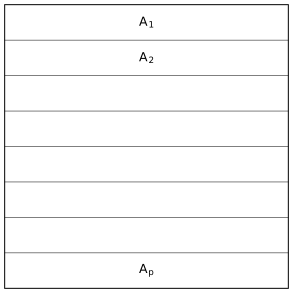
\(A\) is \(n \times n\), \(x\)(input), \(y\)(output) : in global memory
# assume n>p, n%p == 0
PRAM_matvec(A, x, y, n):
  r = n/p
  z = global_read (x)                # CR  - O(n)
  B = global_read (A[tr, :], r)      # ER  - O(n^2/p)
  w = SEQ_matvec (B, z)              # W = O(n^2/p)
  y[tr, (t+1)r] = global_write (w)   # EW  - O(n/p)
scheduling DAGs to PRAM
- scheduling principle: \(T(n,p) \leq \lfloor W(n)/p \rfloor + D(n)\)
- simulate work at \(i_{th}\)—\(W_i(n)\) level using \(p\) processors
- total runtime
\[ \begin{align} T(n,p) & \leq \sum_i \left\lceil\frac{W_i(n)}{p}\right\rceil \\ & \leq \sum_i \left(\left\lfloor\frac{W_i(n)}{p}\right\rfloor + 1 \right) \\ & \leq \left\lfloor\frac{W(n)}{p}\right\rfloor + D(n) \end{align} \]
network models
message passing model
network topologies
- Access to remote data requires communication
- Direct connections would require \(\mathcal{O}(p^2)\) wires and communication ports, which is infeasible for large \(p\)
- Limited connectivity necessitates routing data through intermediate processors or switches
- Topology of network affects algorithm design, implementation, and performance
common network topologies
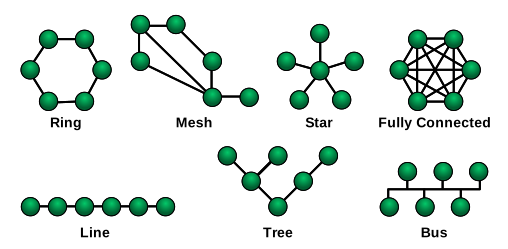
common network topologies
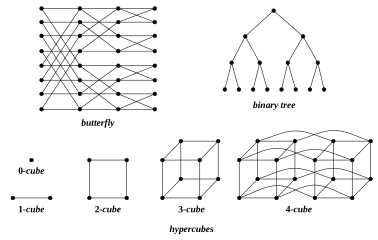
message passing
\(T_{msg} = t_s + t_w L\)
- \(t_s\) = startup time = latency (i.e., time to send message of length zero)
- \(t_w\) = incremental transfer time per word (\(1/t_w\) = bandwidth in words per unit time)
- \(L\) = length of message in words
For most real parallel systems, \(ts \gg tw\)
cost of collectives
reduction

ring reduction pseudocode
reduction(A, id, p) {
  s=A
  for k=0:log2(p)-1 {
    r = 2^k;
    cid = id/r;
    if ~isInt(cid) break; end

    if even(cid) {
      partner = (cid+1)*r;
      recv (sp, partner);
      s=s+sp;
    } else {
      partner = (cid-1)*r;
      send(s, partner);
    }
  }
  return s;
}
hypercube
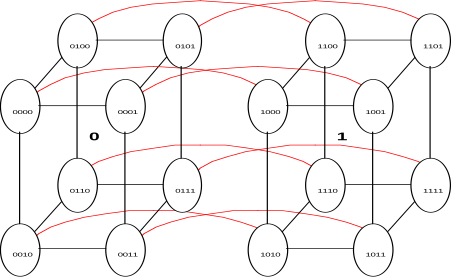
hypercube reduction
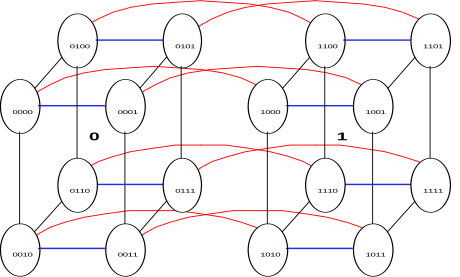
hypercube reduction
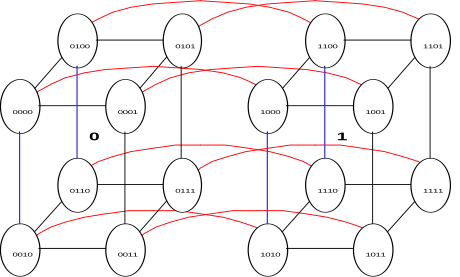
hypercube reduction
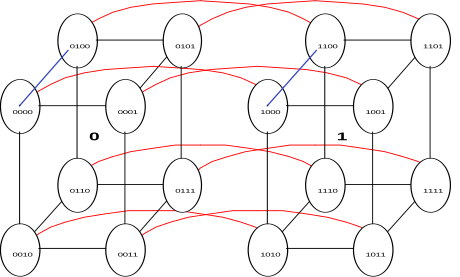
hypercube reduction
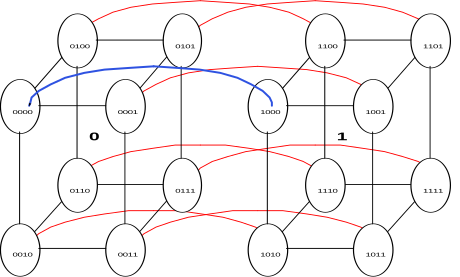
hypercube reduction
hcube_reduction(A, id, p) {
  d = log2(p);
  s = A;
  mask = 0;
  for k=0:d-1 {
    r = 2^k;

    // run only if id's lower k bits == 0
    if id & mask == 0 {
      partner = id ^ r; // flip the kth bit
      if id & r {
        send(s, partner);
      } else {
        recv(sp, partner);
        s = s + sp;
      }
    }
    mask = mask ^ r; % lower k bits = 1
  }
}
broadcast
source node sends the same message to each of \(p-1\) other nodes
int MPI_Bcast (void* buffer, int count, MPI_Datatype datatype,
               int root, MPI_Comm comm);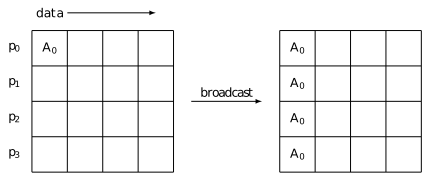
broadcast
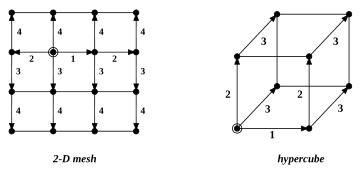
broadcast
Cost of broadcast depends on network, for example
————|—————————— 1-D mesh | \(T=(p-1)(t_s + t_wL)\) 2-D mesh | \(T=2(\sqrt{p}-1)(t_s + t_wL)\) hypercube | \(T=\log p (t_s + t_wL)\)
scatter & gather
int MPI_Gather(void* sbuf, int scount, MPI_Datatype stype,
               void* rbuf, int rcount, MPI_Datatype rtype,
               int root, MPI_Comm comm )

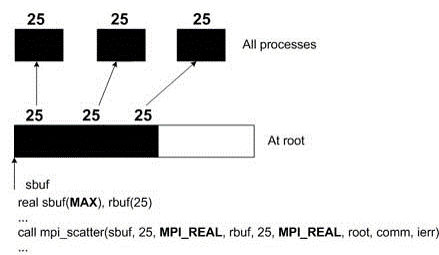
int MPI_Scatter(void* sbuf, int scount, MPI_Datatype stype,
                void* rbuf, int rcount, MPI_Datatype rtype,
                int root, MPI_Comm comm)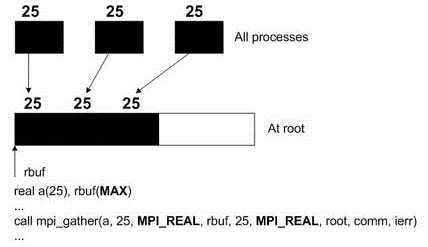
scatter & gather
int MPI_Gather(void* sbuf, int scount, MPI_Datatype stype,
void* rbuf, int rcount, MPI_Datatype rtype,
int root, MPI_Comm comm )

int MPI_Scatter(void* sbuf, int scount, MPI_Datatype stype,
void* rbuf, int rcount, MPI_Datatype rtype,
int root, MPI_Comm comm)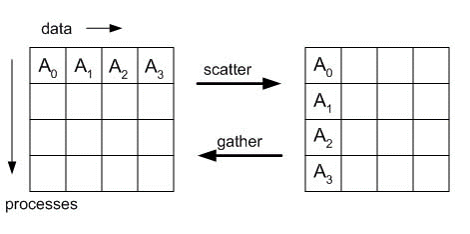
allgather
int MPI_Allgather(void* sbuf, int scount, MPI_Datatype stype,
                  void* rbuf, int rcount, MPI_Datatype rtype, MPI_Comm comm)
all to all
int MPI_Alltoall(void* sbuf, int scount, MPI_Datatype stype,
                 void* rbuf, int rcount, MPI_Datatype rtype, MPI_Comm comm)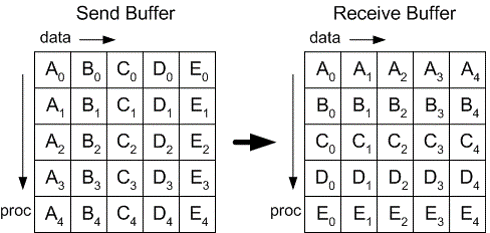
scan, prefix sum
- Given an array, \([4, 2, 1, 8]\)
- Compute, \([4, 4+2, 4+2+1, 4+2+1+8]\)
- \([4, 6, 7, 15]\)
obvious sequential algorithm
\[ D_s(n) = (n) \]
not parallelizable, need to change algorithm
recursive scan
s = Rec_Scan(a,n)
// s[k]= a[0]+a[1]+…+a[k-1], k=0,…,n-1
1.  if n=1 { s[0]←a[0]; return; } //base case
2.  par for (i=0; i<n/2; ++i)
      b[i] ← a[2i] + a[2i+1];
3.  c ← Rec_Scan (b, n/2);
4.  s[0] ← a[0];
5.  par for (i=0; i<n; ++i)
      if isOdd(i)
        s[i] ← c[i/2];
      else if isEven(i)
        s[i] ← c[i/2] + a[i];
reading
Intro to Parallel Algorithms
first chapter of Jájá’s book.