Office: 2780 WEB
E-mail: hantran (at) cs (dot) utah (dot) edu
Research projects
My research focuses on developing high-performance parallel algorithms for solving challenging applied mechanics and engineering problems.
The methods are scalable on modern heterogeneous architectures, which are used to solve large-scale engineering problems.
Below is a summary of specific research topics that I have been conducting together with related publications and achievements.
Full list of my publications is on Google Scholar page.
High-performance approaches for PDE solvers
Data movement in irregular applications (e.g., problems with frequent refinements or enrichments) is a significant challenge for achieving good performance on modern heterogeneous architectures.
I am interested in developing new methods to solve large systems of equations that reduce communication overhead and enable efficient parallelization using MPI, SIMD, OpenMP, and CUDA. overlapping data transfer with kernel execution
Related publications
Han D. Tran, Siddharth Saurav, P. Sadayappan, Sandip Mazumder, and Hari Sundar, "Scalable parallelization for the solution of phonon Boltzmann Transport Equation",
37th International Conference on Supercomputing (ICS '23), 2023, pp. 215-226, doi: 10.1145/3577193.3593723
link
H.D. Tran, M. Fernando, K. Saurabh, B. Ganapathysubramanian, R.M. Kirby and H. Sundar,
“A scalable adaptive-matrix SpMV for heterogeneous architectures”,
2022 IEEE International Parallel & Distributed Processing Symposium (IPDPS), 2022, pp. 13-24, doi: 10.1109/IPDPS53621.2022.00011
link
Crack modeling
Since cracks exist in all structures, crack modeling is essential in the designing and manufacturing processes.
Although the finite element method (FEM) is a powerful tool to analyze most engineering problems,
it has significant drawbacks when applied to crack modeling due to re-meshing difficulty.
BEM is an excellent alternative to FEM to overcome this difficulty because BEM requires discretizing only the boundary and the crack surfaces in the absence of body forces.
BEM and IGA combination provides a further enhancement for crack modeling because both BEM and IGA have a common feature of modeling structures via surfaces but not the interior. radial displacements(left) and NURBS discretization (right) in IGA-SGBEM
Related publications
B.H. Nguyen, S.S. Nanthakumar, Y.Q. He, H.D. Tran, K. Hackl, X. Zhuang,
“Forward and inverse problems in piezoelectricity using isogeometric symmetric Galerkin boundary element method and level set method”,
Engineering Analysis with Boundary Elements (2020) 113:118-132.
link
B.H. Nguyen, X. Zhuang, P. Wriggers, T. Rabczuk, M.E. Mear, H.D. Tran,
“Isogeometric symmetric Galerkin boundary element method for three-dimensional elasticity problems”,
Computer Methods in Applied Mechanics and Engineering (2017) 323:132-150.
link
Han D. Tran and Binh H. Nguyen,
“An isogeometric SGBEM for crack problems of magneto-electro-elastic materials”,
Vietnam Journal of Mechanics (2017) 39:135-147.
link
B.H. Nguyen, H.D. Tran, C. Anitescu, X. Zhuang and T. Rabczuk,
“An isogeometric symmetric Galerkin boundary element method for two-dimensional crack problems”,
Computer Methods in Applied Mechanics and Engineering (2016) 306:252-275.
link
Sea ice modeling
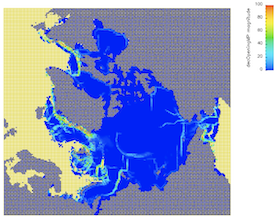
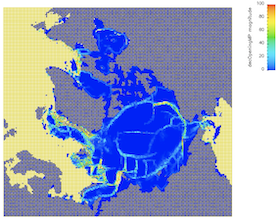
The strength of sea ice is not isotropic but varies with the thickness and lead orientation.
We developed an anisotropic elastic-decohesive constitutive relation for sea ice to capture the pack ice's anisotropically mechanical response.
This development provides a simple yet accurate constitutive relation for sea ice, which applies to both elastic and cracked regimes. crack growth modeling in full Arctic
Related publication
Han D. Tran, Deborah L. Sulsky and Howard L. Schreyer,
“An anisotropic elastic-decohesive constitutive relation for sea ice”,
International Journal for Numerical and Analytical Methods in Geomechanics (2015) 39: 988-1013.
link
Invited talks
Han D. Tran (presenter), Deborah L. Sulsky and Howard L. Schreyer,
“An anisotropic elastic-decohesive constitutive relation for sea ice”,
Workshop on Ice Fracture and Cracks, Isaac Newton Institute for Mathematical Science, Cambridge UK, December 4-8, 2017.
workshop link,
presentation video link
Deborah L. Sulsky (presenter), Han D. Tran and Howard L. Schreyer,
“An anisotropic, elastic-decohesive constitutive relation for modeling Arctic sea ice”,
American Geophysical Union (AGU) Fall Meeting, San Francisco, December 12-16, 2016.
link
Deborah L. Sulsky (presenter), Han D. Tran and Howard L. Schreyer,
“A multiscale, anisotropic, elastic-decohesive constitutive relation for modeling sea ice”,
USACM/IUTAM Symposium on Connecting Multiscale Mechanics to Complex Material Design, Evanston, Illinois, May 14-16, 2014.
link
Conference/Workshop presentations
D. Sulsky (presenter), H. Tran and H. Schreyer,
“A multiscale, anisotropic, elastic-decohesive constitutive relation for
modeling sea ice”,
Joint Mathematics Meetings, Seattle, Washington, January 6-9, 2016.
Deborah L. Sulsky (presenter), Han D. Tran and Howard L. Schreyer,
“Anisotropic, elastic-decohesive constitutive relation for modeling sea ice”,
Symposium on Sea-ice Mechanical Modeling: from physics to applied mathematics, Grenoble, France, June 3-5, 2014.
Han D. Tran (presenter), Deborah L. Sulsky and Howard L. Schreyer,
“An anisotropic elastic-decohesive constitutive relation for modeling sea ice”,
12th U.S. National Congress on Computational Mechanics, Raleigh, North Carolina, July 22-25, 2013.
link
Regularization of singular integral equations for crack modeling:
The governing integral equations in boundary element methods (BEM) contain strongly singular and hyper-singular kernels,
which gives difficulties for the numerical integration.
The singularity is particularly challenging for problems of anisotropic elasticity, piezoelectricity, magneto-electro-elasticity.
We have developed a systematic procedure to regularize these boundary integral equations, which applies to general multi-field materials.
The developed integral equations serve as essential ingredients for creating a weakly-singular symmetric Galerkin BEM used for crack modeling and crack-growth simulation in structures made of multi-field materials. simulation of crack growth using SGBEM
Related publications
Han D. Tran and Mark E. Mear,
“Calculation of T-stress for cracks in two-dimensional anisotropic elastic media by boundary integral equation method”,
International Journal of Fracture (2018) 211:149-162.
link
Han D. Tran and Mark E. Mear,
“A weakly-singular SGBEM for analysis of two-dimensional crack problems in multi-field media”,
Engineering Analysis with Boundary Elements (2014) 41: 60-73.
link
Han D. Tran and Mark E. Mear,
“Regularized boundary integral equations for two-dimensional crack problems in multi-field media”,
International Journal of Fracture (2013) 181: 99-113.
link
Conference/Workshop presentations
Han D. Tran (presenter) and Mark E. Mear,
“Calculation of T-tress for cracks in two-dimensional anisotropic elastic media by boundary integral equation method",
14th U.S. National Congress on Computational Mechanics, Montreal, Canada, July 17-20, 2017.
link
Han D. Tran (presenter) and Mark E. Mear,
“A weakly-singular SGBEM for analysis of cracks in 2D multi-field media",
11th U.S. National Congress on Computational Mechanics, Minneapolis, Minnesota, July 25-28, 2011.
link
Best poster award
Han D. Tran (presenter) and Mark E. Mear,
“A weakly-singular SGBEM for analysis of cracks in 2D multi-field media",
NSF Workshop on the Emerging Applications and Future Directions of the Boundary Element Method, Cleveland, Ohio, September 1-3, 2010.
link