A Privacy-First Wearable Sensing Platform
MotionPI was developed in the Kahlert School of Computing at the University of Utah by Foad Namjoo under the supervision of Jeff M. Phillips. It is a privacy-first, distributed sensing platform that integrates a smartphone application with BLE-enabled wristbands to support reliable, large-scale data collection in real-world field studies. The system is engineered for robustness, longevity, and participant privacy, and has been built and deployed through close collaboration with the Department of Health & Kinesiology Sciences, the Huntsman Cancer Institute, the College of Social & Behavioral Science, and wearable hardware teams at the College of Engineering at The Ohio State University.
MotionPI Publication
Paper: arXiv:2510.19938This interdisciplinary effort resulted in the SmartSP 2025 paper. For more technical details about the system design and reliability framework, see our preprint on arXiv:
Designing a Secure and Resilient Distributed Smartphone Participant Data Collection System.
MotionPI App Example Screens
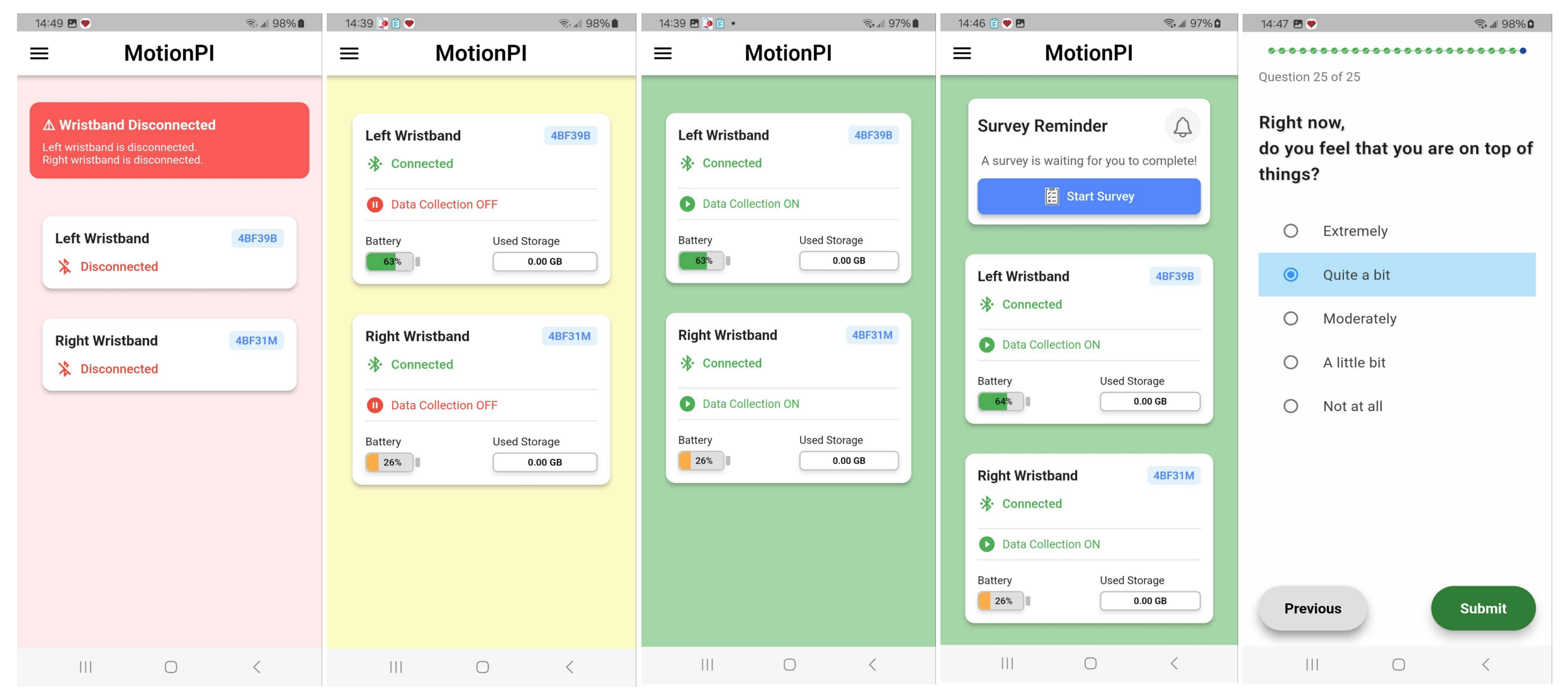
Example MotionPI app states, including connectivity status, wristband battery and storage, data-collection indicators, BLE connection status, and Ecological Momentary Assessment (EMA) survey interfaces.
At its core, MotionPI uses a Flutter-based mobile application that performs continuous sensing, manages background processes, buffers data offline when necessary, and automatically recovers from interruptions. Custom wristbands developed at OSU stream IMU and ENMO data along with battery, storage, and charging information, while the app maintains stable BLE communication through intelligent reconnection and resubscription logic. All sensor data is sent to a Node.js and Express backend, where MongoDB stores only schema-validated records. This strict validation pipeline enabled the system to handle nearly 7.7 million records per day without producing a single malformed write during deployment.
Privacy and reliability are built into the system’s foundation. No login information or PHI is ever collected; instead, the app uses the device’s advertising ID as an anonymous participant identifier. MotionPI is designed to withstand real-world constraints, including Bluetooth dropouts, background task interruptions, and intermittent network availability, automatically restoring full functionality and synchronizing buffered data.
MotionPI Wristband Hardware

Pre-Pilot System Validation
During pre-pilot testing, we validated the end-to-end pipeline: left- and right-hand wristbands were shaken in separate bags to simulate continuous activity and trigger the 7-minute MVPA rule. The wristbands detected activity, sent a trigger bit over BLE, and the phone delivered an Ecological Momentary Assessment (EMA) survey notification. PPG sensors (green indicator) remained active during activity for HR/HRV measurement. This confirms firmware, BLE sync, app logic, and sensor integration before the pilot study.
32-second validation clip: wristbands trigger Ecological Momentary Assessment (EMA) survey after 7-minute activity threshold.
High-Resolution Location Accuracy
MotionPI collects GPS samples every five seconds during study periods, enabling precise reconstruction of movement patterns while maintaining strict privacy safeguards. The trajectory shown below is a decrypted-for-visualization validation example from a test participant, illustrating the high positional accuracy achieved after secure processing. All location traces remain encrypted at rest, anonymized, and never linked to personal identifiers; only aggregated or de-identified outputs are accessible, and solely to a restricted group of authorized study researchers.
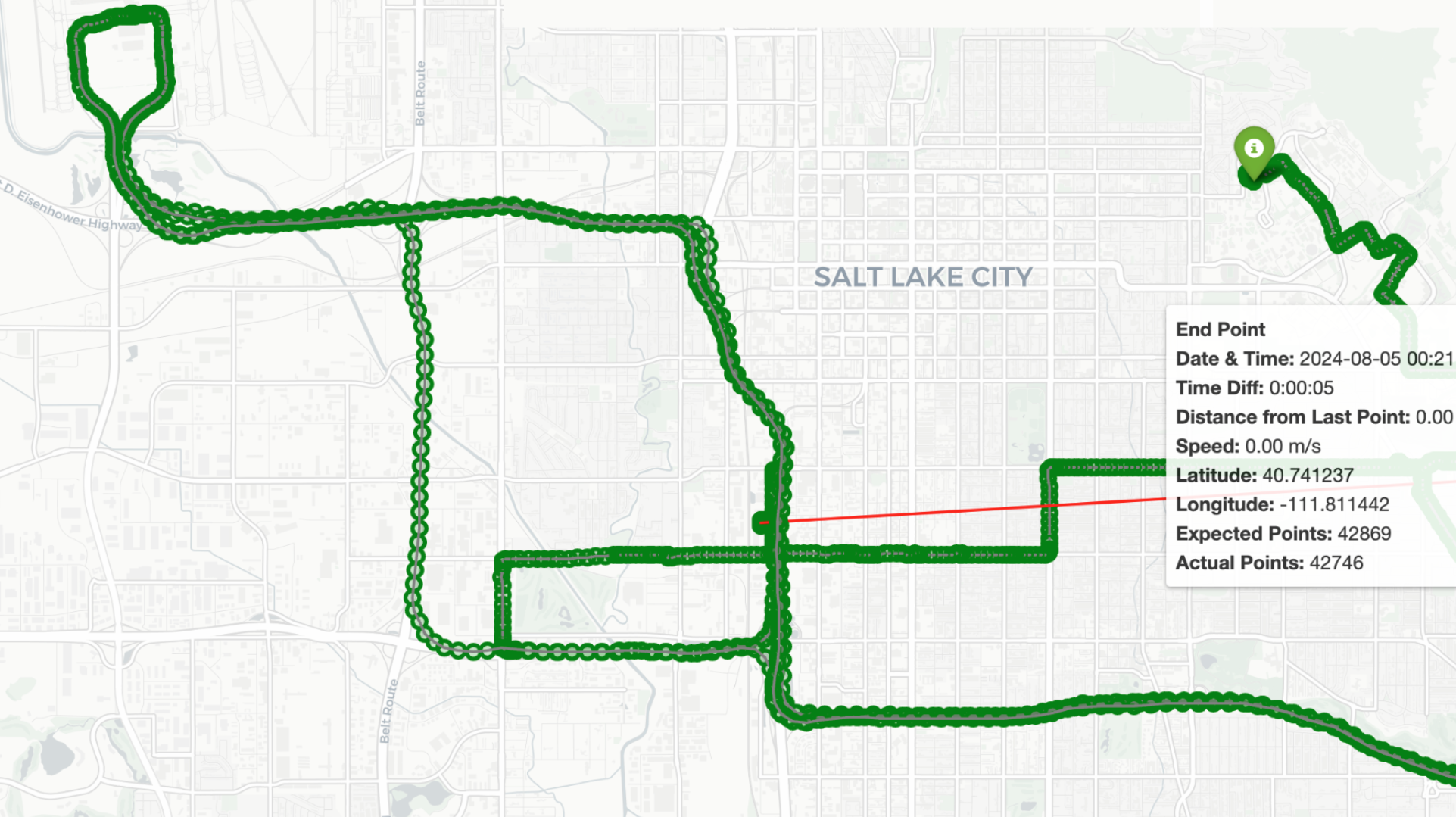
Five-second GPS trajectory from a test participant, showing MotionPI’s high-accuracy location reconstruction after secure decryption. Raw GPS traces remain encrypted, anonymized, and never tied to personal identity.
ENMO-Based Activity Detection in MotionPI
MotionPI incorporates a real-time physical activity detection pipeline built on ENMO (Euclidean Norm Minus One), a gravity-adjusted measure of acceleration magnitude. MotionSense wristbands compute ENMO continuously and transmit 15-second averaged values to the phone, where MotionPI processes them to identify meaningful activity bouts. When 70% of ENMO values within a 7-minute sliding window exceed the intensity threshold of 100.6 mg, the system classifies the period as moderate-to-vigorous physical activity (MVPA). The wristband then transmits a trigger bit to the phone, prompting MotionPI to deliver an activity Ecological Momentary Assessment (EMA) survey at the moment the behavior occurs.

Animated ENMO-based activity detection demo. The green window shows the 7-minute sliding activity window; when 70% of ENMO values exceed 100.6 mg, MotionPI classifies the segment as moderate-to-vigorous physical activity (MVPA) and triggers an Ecological Momentary Assessment (EMA) survey.
Interactive version: Open full ENMO visualization in a new tab
This ENMO-triggered survey mechanism allows MotionPI to capture contextual, psychosocial, and environmental factors surrounding moments of real physical activity—something that traditional surveys and retrospective recall cannot achieve.
By tying real-time sensing to real-time self-report, MotionPI provides researchers with high-resolution insight into why activity occurs (or fails to occur) in everyday life.
If you are interested in collaborating on wearable sensing systems, distributed data pipelines, or reliability-focused mobile systems, please feel free to reach out.